
Dear PERK Members,
In our last update, we shared that Judge Edward Davila had denied TikTok, Meta, and Google’s bid to block SB 976, holding that addictive algorithmic feeds are not protected speech. We also told you the platforms might appeal.
They did.
Meta, Google and YouTube, and TikTok have taken their case to the U.S. Court of Appeals for the Ninth Circuit. On October 20, PERK asked the Court for permission to file a new amicus brief in support of the State of California, and submitted that brief, urging the Court to affirm the ruling and keep California’s child protections in place.
The State of California has consented to our filing. The Court will now decide whether to accept it.
What we told the Court
Our brief, filed by attorney Tony Francois, makes three arguments.
First, the evidence is in, and the industry has admitted it. Research links compulsive social media use to psychological distress, depression, and poor sleep, with early adolescents especially vulnerable. Former Facebook leaders have described their own product as built on “dopamine-driven feedback loops.” Meta’s own internal research reportedly found that its parental controls do little to curb compulsive use by teens. And the CEO of TikTok does not let his own children use the platform.
Second, addictive design is not speech. The platforms argue that their algorithms deserve the same First Amendment protection as a newspaper. Our brief offers a simpler comparison: a fortune cookie has words inside it, but that doesn’t put the recipe beyond the reach of the law. The question is not the words on the screen. It is a technology engineered to exploit a child’s brain chemistry and keep them scrolling.
Third, parents have a fundamental right to direct the upbringing of their children. The Supreme Court recognized that right nearly a century ago in Pierce v. Society of Sisters. Today, parents are technologically outgunned by some of the most powerful companies in the world. SB 976 does not take that authority from parents. It protects it.
What this means for families
For now, California’s protections remain in place while the appeal moves forward. Platforms may not deliver addictive algorithmic feeds to a minor without parental consent, and companies have until January 1, 2027 to comply.
We want to be measured about where things stand. This is an appeal of a preliminary ruling. The Court has not yet decided whether to accept our brief, and the platforms may still prevail. Nothing here is final.
But the voice of parents will be in front of the Ninth Circuit, just as it was in the court below.
The same test, every time
Does the law strengthen a parent’s hand, or take it away?
SB 976 strengthens it. That is why PERK stood beside California in the district court, and why we’re standing there again on appeal. It’s the same reason we continue to fight laws like SB 277 that take a parent’s hand away.
We are not for the state or against the state. We are for parents. We are for protecting children.
Children are not products. Parents are not powerless. And we will keep making that case for as long as it takes.
With gratitude,
Amy Bohn
Co-Founder and CEO, PERK
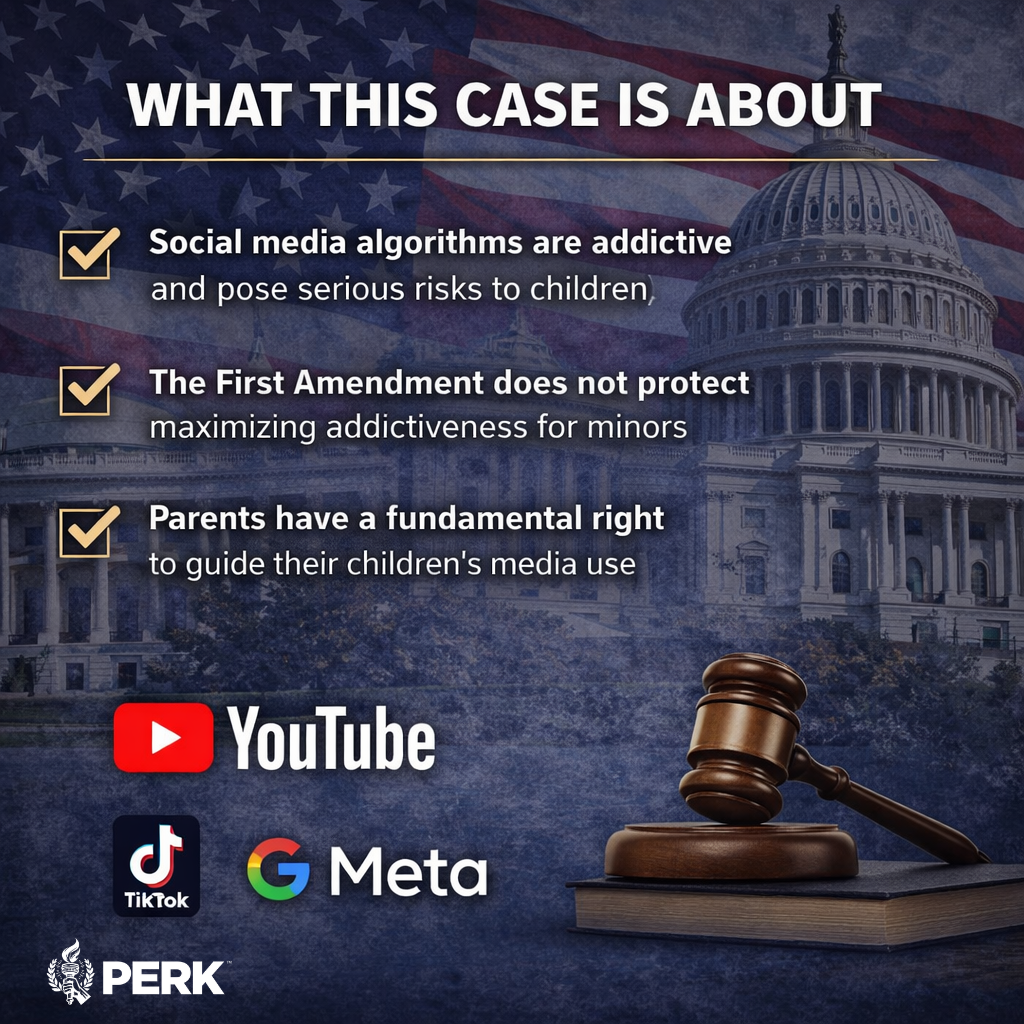

Meta, Google, and TikTok appealed. PERK followed, filing a new amicus brief in the Ninth Circuit urging the Court to uphold California’s SB 976 child protections.